
The Coalition in Manila: Global Ministerial Conference on Ending VAC
The Coalition’s co-founders and members will be in Manila to highlight “safe and enabling schools” as a key breakthrough strategy for violence against children (VAC) prevention at scale, and to bring perspectives and voices often missing from the global stage into the conversation.
Through each of the below conference Plenary and Parallel sessions and official satellite events, the Coalition for Good Schools is calling on governments, development partners and funders to recognize education systems as a central pathway for preventing violence against children, and to recognize civil society as a partner and co-leader.
Our key strategic messages that we will bring with us to Manila explain why schools are an efficient and promising place to act—and identify four commitments needed to make prevention sustainable and scalable.
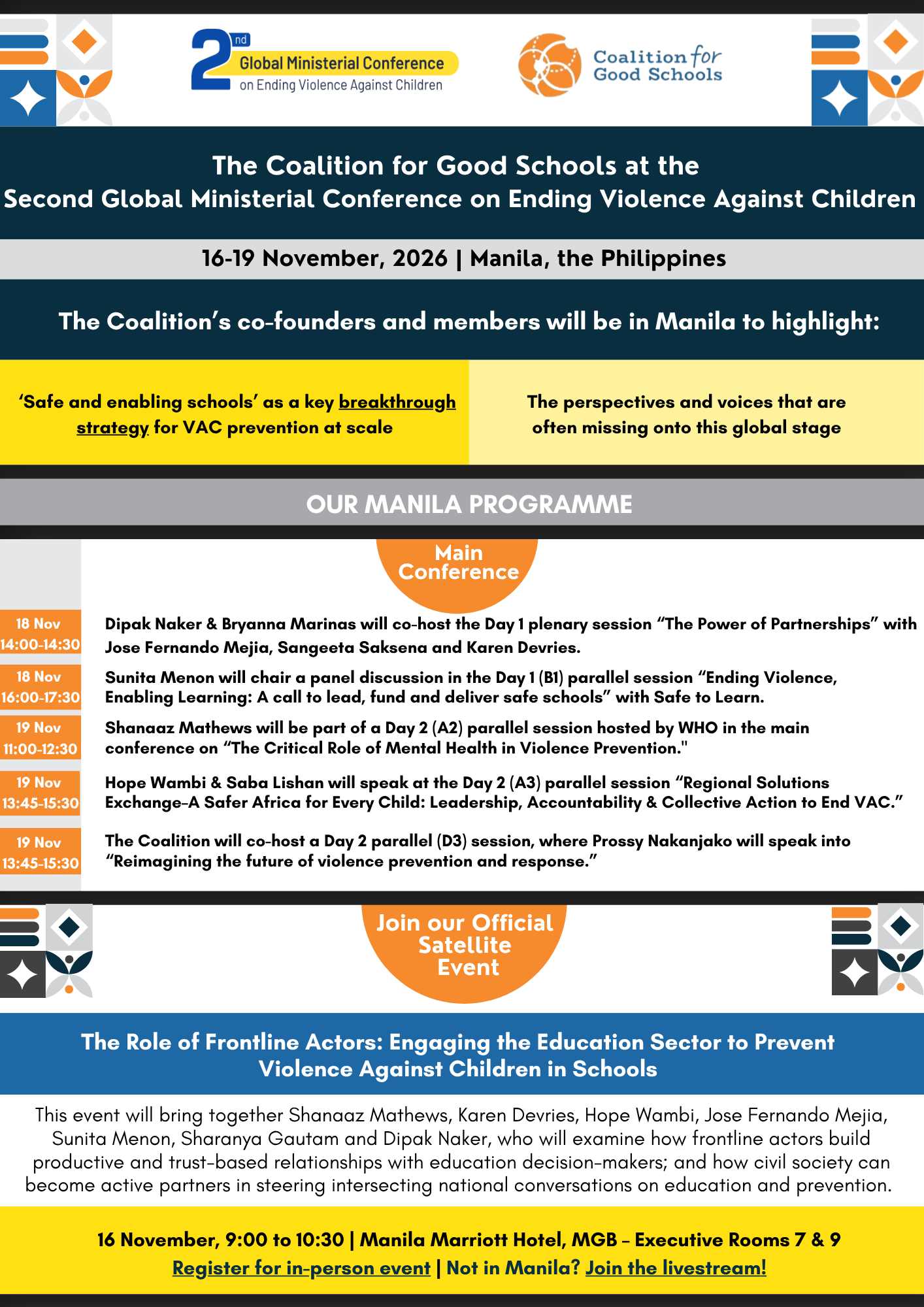
Join our Official Satellite Event:
The Role of Frontline Actors: Engaging the Education Sector to Prevent Violence Against Children in Schools.
Education systems provide an unparalleled opportunity for preventing violence against children at scale. Effective prevention, however, requires more than interventions in schools – it requires sustained collaboration between education systems, governments, civil society and young people. Frontline civil society organizations bring distinctive expertise: deep contextual knowledge, trusted relationships with communities, experience adapting and implementing evidence-based approaches, and the ability to test innovations, generate learning and build momentum for change. Our official satellite event brings these frontline collaborators to the table to share learning from what effective civil society collaborations look like in practice.
Objectives
- Unpack the distinctive and indispensable contribution of frontline civil society actors to prevent violence through education sector at scale in the Global South.
- Identify lessons from successful civil society partnerships across Africa, Asia and Latin America.
- Explore how civil society acts as a strategic partner to government in shaping national prevention priorities, policy and practice.
16 November, 9:00-10:30am, Manila Marriott Hotel, MGB – Executive Rooms 7 & 9
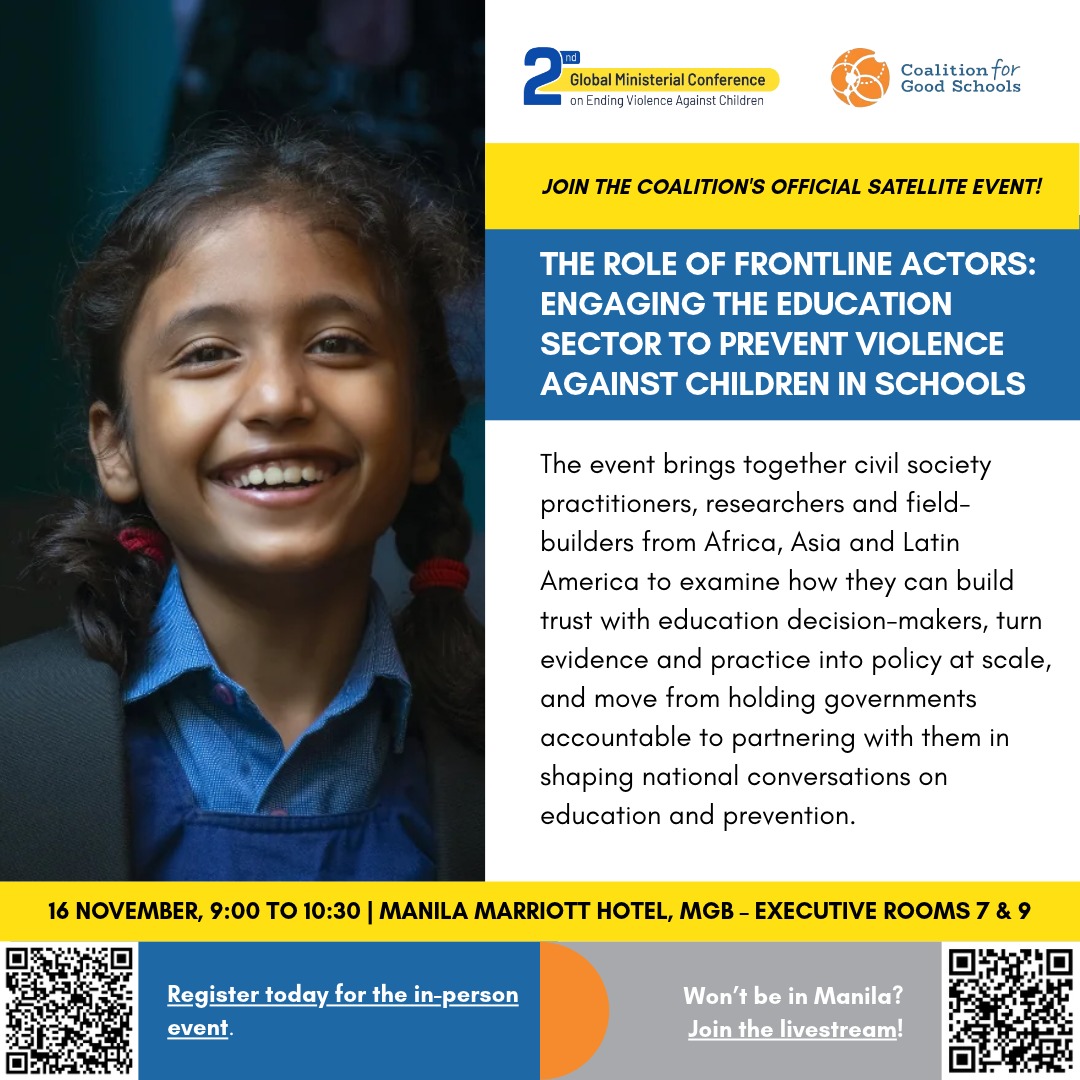
Satellite Event:
Global South Civil Society Actors: Building a Foundation for Action to Prevent Violence Against Children at Scale
In partnership with strategic allies, the Coalition will co-host a full-day satellite event focused on frontline, Global South-rooted practitioners, researchers and networks who have provided decades of leadership on VAC prevention. This event is invite-only.
17 November | 9:00–16:30 | MHM The Den and Veranda,
Satellite Event:
From Evidence to Action: Evidence & Data-Driven Action for Safe & Enabling Learning Environments
The Coalition’s Latin America Hub will join the Center for Global Development, UNICEF and Safe to Learn to share evidence and country-level experience on preventing VAC in and around schools, how governments use evidence to inform national efforts, and remaining gaps in knowledge, implementation and policy. The session features Lina Maria Saldarriaga and Sohini Bhattacharya.
16 November | 10:45–12:00 | Executive Rooms 7 & 9, Marriott Hotel at Newport
Other Events we are Watching
· 16 November | 16:45–17:45 — Cities for Children (Asia Hub) will host “From Legislation to Classrooms: Ending Corporal Punishment Through School-Based Interventions,” with Madeeha Ansari and Stella Ayo-Odongo. Register here.
· 16 November | 8:45–17:00 — Dr. Bernadette Madrid will co-host the invite-only AKO PARA SA BATA Conference, “From Practice to Scale: Experiences and Innovations in Philippine Child Protection.” Learn more here.
· 17 November | 10:15–11:45 — Shanaaz Mathews will join a satellite event panel convened by What Works Partnership to End Violence Against Women and Girls, UNESCO and All In.
· 17 November | 14:00–16:45 — Safe to Learn will host its flagship satellite event in Executive Rooms 7 & 9.
Making Missing Voices a part of the conversation
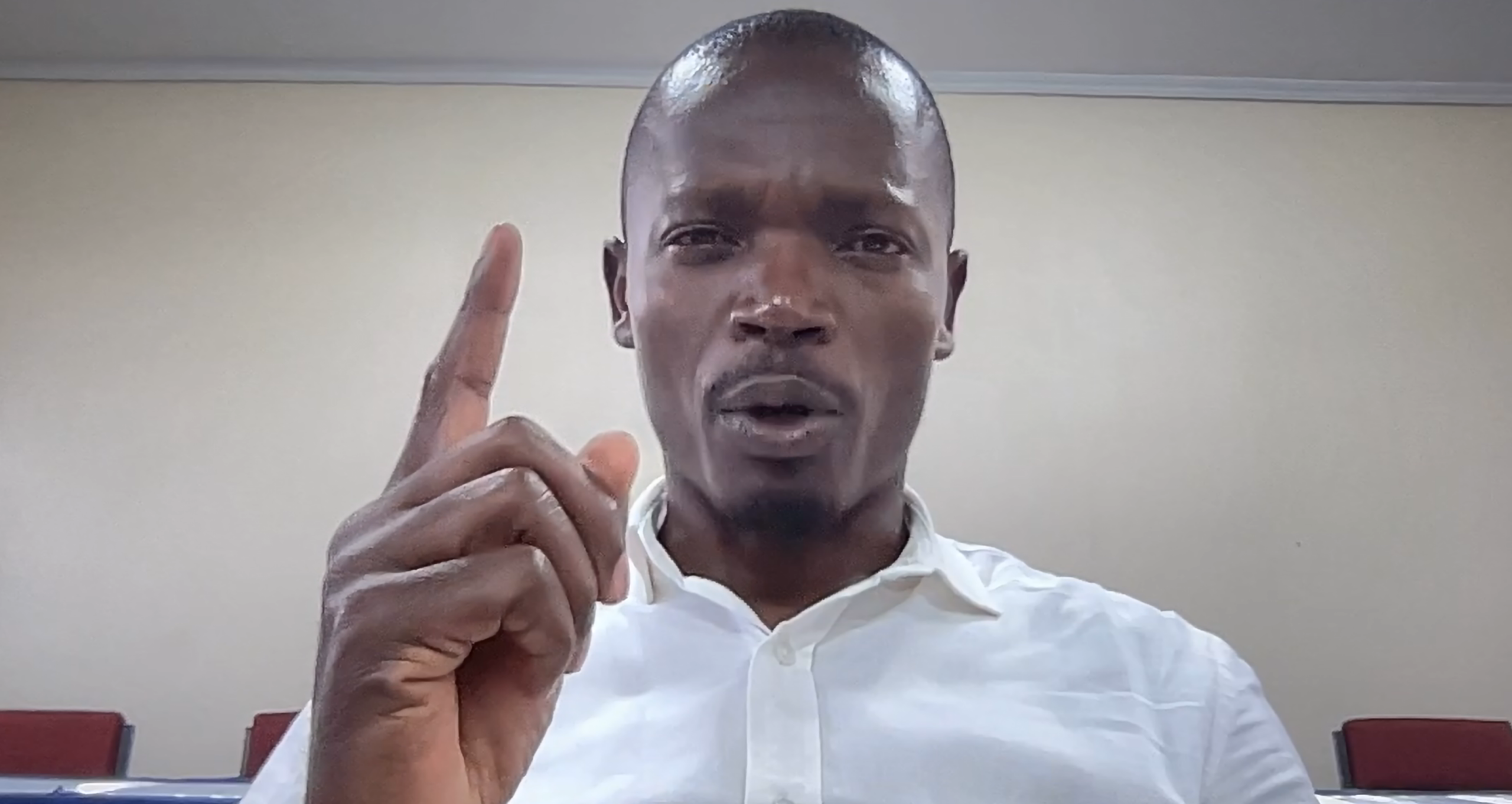
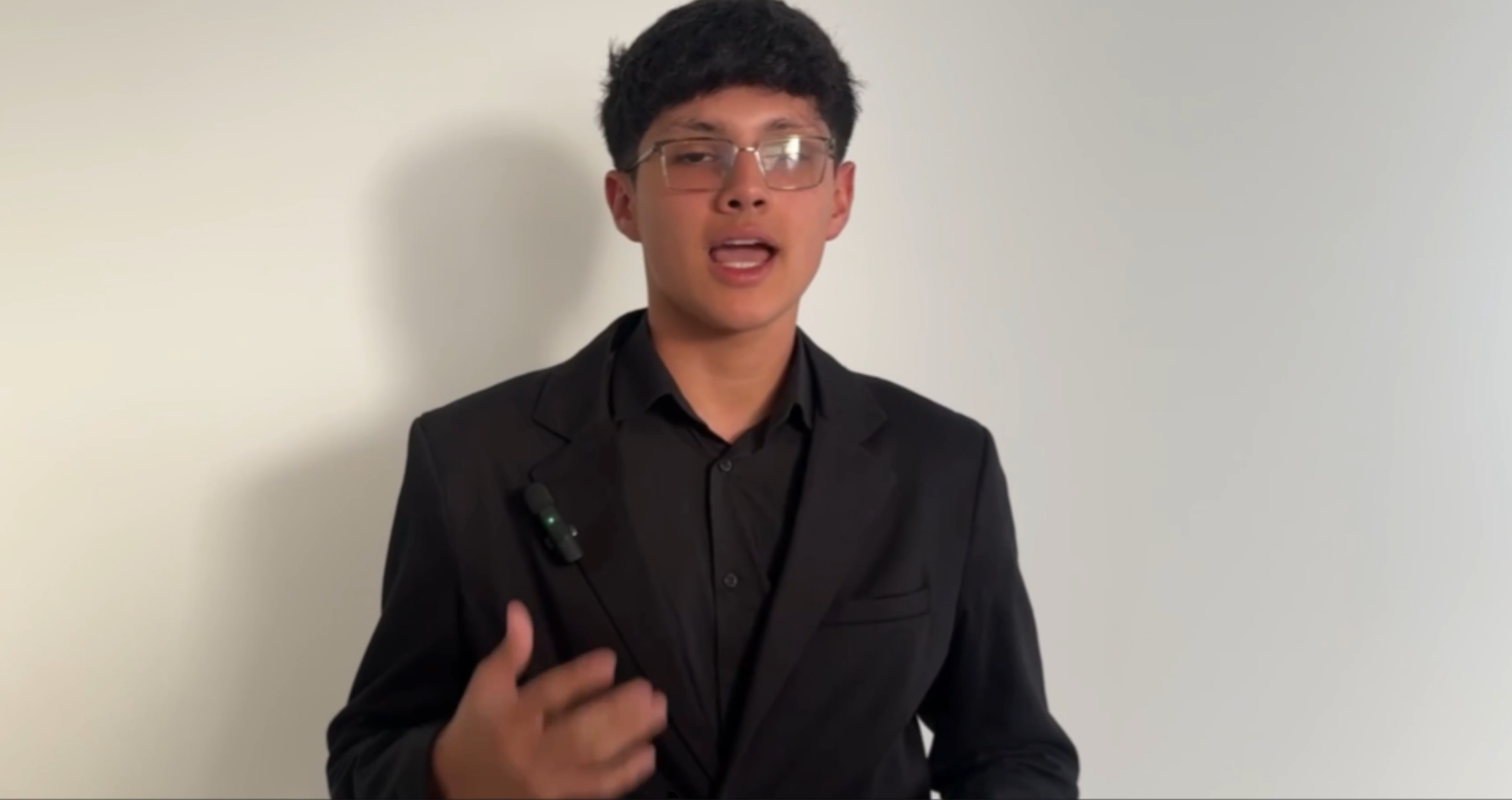
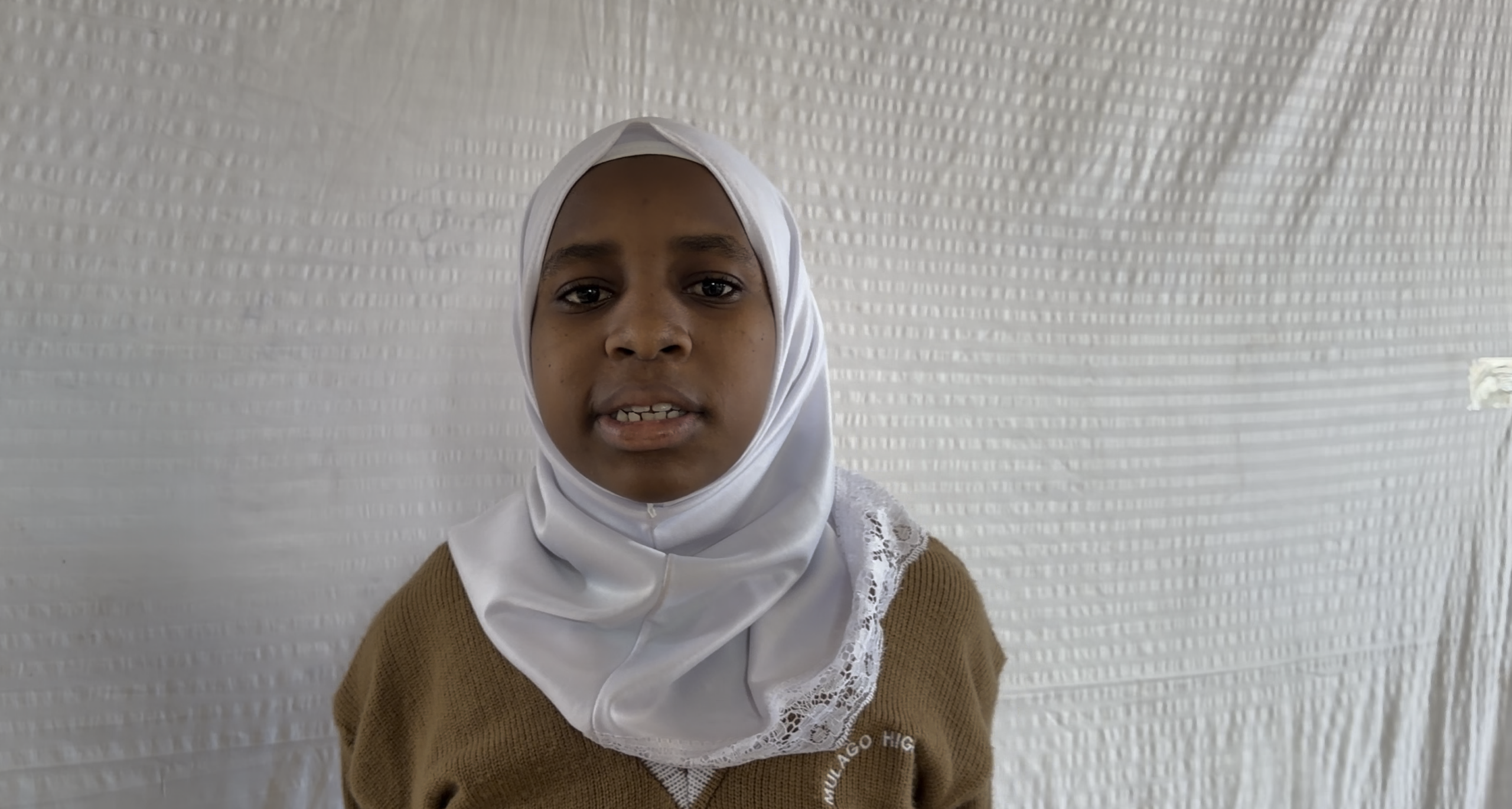
The Missing Voices project will feature prominently across the conference venue! This includes video submissions from dozens of civil society actors, field-leaders, children, survivors, teachers, youth advocates, researchers, community resource persons and many more sharing bold recommendations for how governments and development partners, alongside civil society, need to know to prevent violence against children.
We will also input into a Day 2 plenary led by Helen Morton and featuring Coalition co-founder Sohini Bhattacharya.
We thank you for all of your incredible submissions!
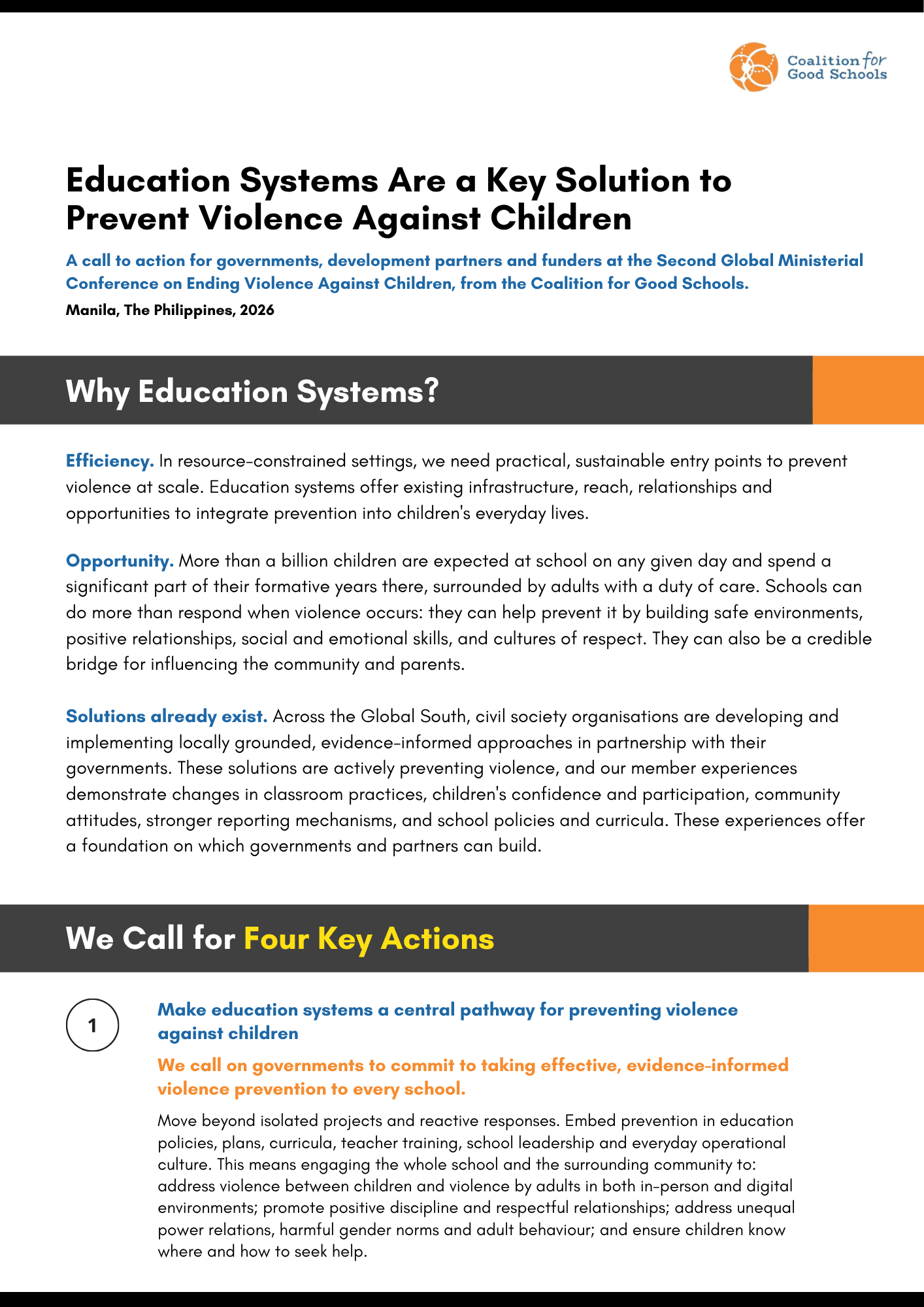
Our Message to Manila: Education systems are a key solution to prevent violence against children
Alongside this programme, the Coalition is calling on governments, development partners and funders to recognize education systems as a central pathway for preventing violence against children. Our key strategic messages explain why schools are an efficient and promising place to act—and identify four commitments needed to make prevention sustainable and scalable.
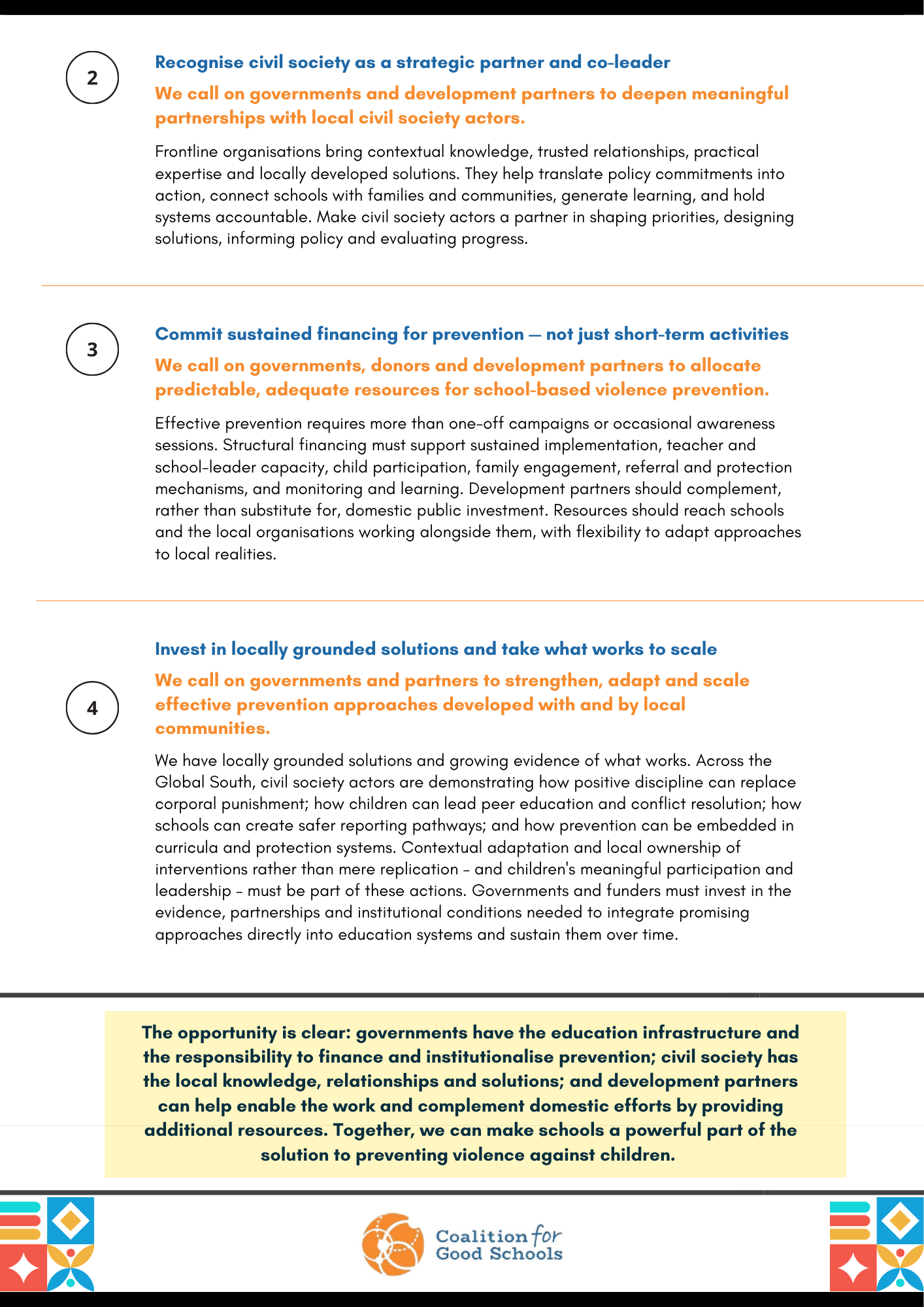
We call for four key actions
1. Make education systems a central pathway for preventing violence against children.
We call on governments to commit to taking effective, evidence-informed violence prevention to every school.
Move beyond isolated projects and reactive responses. Embed prevention in education policies, plans, curricula, teacher training, school leadership and everyday operational culture. This means engaging the whole school and the surrounding community to: address violence between children and violence by adults in both in-person and digital environments; promote positive discipline and respectful relationships; address unequal power relations, harmful gender norms and adult behavior; and ensure children know where and how to seek help.
2. Recognize civil society as a strategic partner and co-leader.
We call on governments and development partners to deepen meaningful partnerships with local civil society actors.
Frontline organizations bring contextual knowledge, trusted relationships, practical expertise and locally developed solutions. They help translate policy commitments into action, connect schools with families and communities, generate learning, and hold systems accountable. Make civil society actors a partner in shaping priorities, designing solutions, informing policy and evaluating progress.
3. Commit sustained financing for prevention—not just short-term activities.
We call on governments, donors and development partners to allocate predictable, adequate resources for school-based violence prevention.
Effective prevention requires more than one-off campaigns or occasional awareness sessions. Structural financing must support sustained implementation, teacher and school-leader capacity, child participation, family engagement, referral and protection mechanisms, and monitoring and learning. Development partners should complement, rather than substitute for, domestic public investment. Resources should reach schools and the local organizations working alongside them, with flexibility to adapt approaches to local realities.
4. Invest in locally grounded solutions and take what works to scale.
We call on governments and partners to strengthen, adapt and scale effective prevention approaches developed with and by local communities.
We have locally grounded solutions and growing evidence of what works. Across the Global South, civil society actors are demonstrating how positive discipline can replace corporal punishment; how children can lead peer education and conflict resolutions; how schools can create safer reporting pathways; and how prevention can be embedded in curricula and protection systems. Contextual adaptation and local ownership of interventions rather than mere replication – and children’s meaningful participation and leadership – must be a part of these actions. Governments and funders must invest in the evidence, partnerships and institutional conditions needed to integrate promising approaches directly into education systems and sustain them over time.
The opportunity is clear: governments have the education infrastructure and the responsibility to finance and institutionalize prevention; civil society has the local knowledge, relationships and solutions; and development partners can help enable the work and complement domestic efforts by providing additional resources. Together, we can make schools a powerful part of the solution to preventing violence against children.