Coalition founders and members reflect on scale at SVRI 2026
Every two years, the Sexual Violence Research Initiative (SVRI) Forum brings together researchers, practitioners, academics and movement leaders working to understand and end violence against women and violence against children. The space serves as a sort of pilgrimage for many who call this movement their home.
The Coalition for Good Schools has been bringing conversations around violence against children including sexual violence in schools – and the opportunity education systems offer to prevent it – to each SVRI Forum since 2021 in Mexico.
At this year’s 2026 Forum in Bangkok, Thailand, the Coalition convened an official participant driven event on Wednesday 7 October. This event offered opportunity for deeper dialogue on what is working to end violence in and through schools at scale in the Global South.
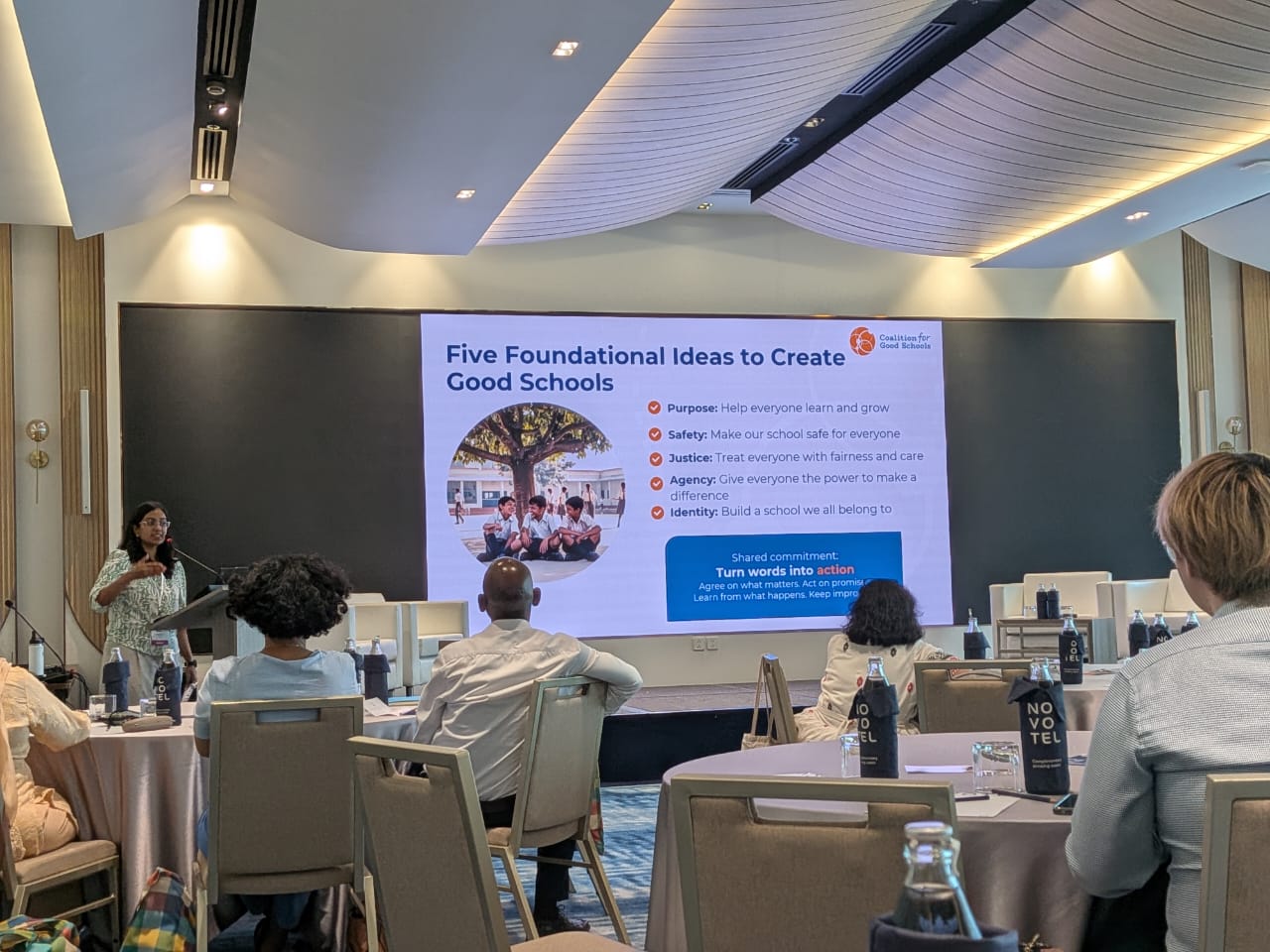
The lunchtime event brought together practice-based insights from the Coalition’s Global Hub on foundational ideas underpinning effective interventions, and sharing on scale efforts from our friends at Arpan India, Right to Play Pakistan, and Evidence & Beyond and LVCT Health in Kenya.
It also shared new learning from collaborations from across the Coalition’s co-founders. This included the launch of the newly formed P.E.A.C.E. collaboration, of which Coalition for Good Schools is a co-founder, and exciting milestones on school-violence prevention at scale from the FCDO-funded What Works Partnership to End Violence Against Women and Girls, of which many Coalition co-founders are a part.
Karen Devries and Jodie Pearlman of LSHTM rooted us in the current evidence on scaling interventions through schools and introduced the group to the P.E.A.C.E. (Partnership to End Abuse in Contexts of Education) – a new collaboration between the Coalition, London School of Hygiene & Tropical Medicine, University of Cape Town and Raising Voices.
Coalition co-founder Shanaaz Mathews then shared recent learnings from the newly launched What Works II Brief on readiness for scale and offered a critical linking point between multiple ongoing collaborations, with considerations for intervention readiness, organizational readiness and government readiness to integrate evidence-based interventions in education systems.
“If you are developing an intervention without scale in mind, you are not developing a scalable intervention.”
Foundational ideas
From the Coalition, Tvisha Nevatia led a presentation on the Global Hub’s newest area of thinking on a foundational intervention to prevent violence at scale. This new project articulates fundamental ideas to inspire schools to imagine a more expansive purpose and help create fertile psychological ground for all subsequent interventions aimed at preventing violence in and through schools.
Tvisha shared from recent learning visits to Uganda and India, as well as consultation with dozens of civil society practitioners and thought leaders in the school-based violence prevention space. This research has focused on identifying key concepts to encourage schools to create opportunities for student participation, foster belonging and model leadership and values.
Tvisha’s sharing in this session and a subsequent ‘five-minute presentation’ slot on Thursday was rooted in the understanding that everyone wants good schools – including governments who are paying closer attention, global policy infrastructure that seeks promising and scalable ideas, and funders investing in efficient pathways. Though while broad aspiration exists for schools to be inclusive, safe, and developmentally nurturing, there is a critical gap in actualizing this vision through a simple and universally appealing framework.
This intervention aims to fill that gap by proposing a scalable foundational pathway to effect systems-level violence prevention in the Global South, a conversation we look forward to building on at the Second Global Ministerial Conference on Ending Violence Against Children.
Learning from practitioners on scale
Coalition co-founder Sohini Bhattacharya, who has spent more than 20 years thinking about how civil society can and should lead gender transformative education and prevention at scale, moderated a dynamic discussion on scale and innovation with Maham Ali Khan of Right to Play Pakistan, Dr. Manjeer Mukherjee of Arpan India, and Anne Ngunjiri of Evidence & Beyond.
A few key themes emerged from this discussion:
- Values aligned partnerships are essential: Trust-based relationships between governments and practitioners – and between practitioners and researchers are a foundation for effective scale. Within researcher-practitioner relationships, we need to continue to think beyond RCTs alone, but evaluation and practice-based insights must go hand in hand (much of what was shared elsewhere in the forum on school prevention was lacking in one side or the other). As our Anne Ngunjiri at Evidence & Beyond reminded us, “ownership grows when partners help interpret evidence, question assumptions and make design decisions. This participation helps shape programmes that fit their context and that people can use.”
- Scale is not optional, but necessary: Shanaaz Mathews reminded participants in the session, “If you are developing an intervention with scale in mind, you are not developing a scalable intervention.” Working through education systems means that the infrastructure already exists to scale horizontally and vertically, and evidence consistently shows that multi-component interventions that address the whole school environment are most effective. If we are not walking the journey to ready our interventions, our organizations and our governments for scaling efforts, we are turning a blind eye to the true opportunity that schools present as a vital prevention ecosystem.
- Safety is not an add-on: Safe learning spaces must be a pre-requisite for learning to take place. Children spend majority of their time in schools with teachers and school staff. It is where they learn social norms on how to relate to one another and how to make sense of power. An environment of violence degrades a person’s dignity, creates anxiety and fear, and affects participation and learning outcomes. When students feel safe and valued, they are able to be creative and can flourish as individuals. A good school has no place for violence in its operational culture.
- Teachers need to heal: Much of the focus of school-based prevention is on teachers. Teachers hold the power and authority to not only model positive discipline and other alternatives to violence punishment in the classroom, but also to teach and model for learners what healthy relationships can look like. Many teachers are themselves parents, and many themselves experienced violence throughout their own lifetimes. Teachers’ traumas inevitably inform their practice, and interventions that focus on offering teachers spaces to heal and walk their own path towards activism for non-violent childhoods are well-placed to support the entire school ecosystem, without blaming or shaming teachers as presumed perpetrators.
Finally, these discussions highlighted how there are no ideal systems: the work we do to transform the ecosystems children find themselves in, as well as embedding prevention into government systems, is incredibly complex, and we are trying to embed our innovations into deeply imperfect systems. Though maintaining considerations for effective scale at each step of the intervention design, piloting, evaluation and adaptation for roll-out is a critical lens through which all our work must operate.

If you’d like to get in touch with Coalition for Good Schools,
send us an email at in**@*********************ls.org
Copyright © 2026 | Coalition for Good Schools
If you’d like to get in touch with Coalition for Good Schools, send us an email at in**@*********************ls.org
SUB-SAHARAN AFRICA
HakiElimu
+255 22 2151852/3
ASIA
Samya
+91 11 41666101 06
LATIN AMERICA
Aulas en Paz
+57 310 8075818
Copyright © 2026 | Coalition for Good Schools